
Epic Games RealityScan
Buy RealityScan 2.2 – Photogrammetry Software for Businesses
ArcTron 3D is an official RealityScan reseller, supporting businesses and public authorities across Germany, Austria, and Switzerland throughout the entire procurement process—from licensing and deployment to training and professional reality capture workflows.
- Official RealityScan Reseller
- B2B Quotations & Invoicing from Germany
- Personal Licensing & Workflow Consulting
- Training & Technical Application Support

RealityScan new software release 2.2 aims for photogrammetry-, SFM- and 3D specialists requiring the highest precision and speed.
Create a 3D model with images, laser scans, UAVs, or synchronized camera rigs
… and mix different inputs to create a visually consistent triangular 3D model. No restrictions.
New features as well as improvements in RealityScan 2.1 :
- AI masking (automatically remove background elements)
- More intelligent alignment
- Supporting LiDAR to combine with ground data
- Quality analysis with visual heat maps
- Improved texturing speed
- Relative paths for input files
- Scale depth maps on export
- Mask layer in texturing
- Option to create non-watertight models
- Export COLMAP files
- Export DSM and DTM as 16-bit PNG files
- Larger UV islands with texture defragmentation
- Higher bit depth support for photoconsistency texturing
- Export in USD or USDZ format
- Display reconstruction region widget after activating the “Cut by Box” tool
- Export normal maps with GLB format
- Export radiance fields transformation file
Label layer image validation - Group inputs by their paths in the 1Ds view for a clearer overview [beta]
The Epic Ecosystem for Reality Capture, Visualization, and Real-Time Applications
RealityScan, Twinmotion and Unreal Engine - buy from one Single Source
RealityScan is part of the professional Epic Developer Suite and integrates seamlessly with Twinmotion and Unreal Engine. This enables end-to-end workflows—from accurate 3D data capture and photorealistic real-time visualization to interactive digital twins, VR/AR applications, and simulations.
As an official Epic reseller, we support businesses throughout the selection, licensing, and deployment of the entire product portfolio.
RealityScan
Reality Capture & Photogrammetry
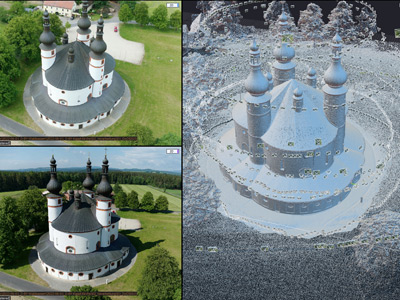
- Highly Accurate 3D Models from Photographs and Laser Scan Data
- LiDAR and Photogrammetry Workflows
- Orthophotos, Meshes, and Point Clouds
- Optimized for Large-Scale Datasets
Unreal Engine
Digital Twins & XR

- Architecture and Infrastructure Visualization
- Presentations for Clients and Stakeholders
- Animations and Videos
- Code-Free VR Presentations
Twinmotion
Real-Time 3D Visualization
- Interactive Digital Twins
- VR, AR, and MR Applications
- Industrial Simulations
- Training and Learning Systems
- Custom Software Solutions
RealityScan - Unique in Every Regard
The photogrammetry software RealityScan is extremely fast, has a highly modern and innovative core and a number of unique features – a power package that is changing the industry!
Go beyond the 3D limits of what can be achieved with photogrammetric methods with amazing speed, quality and accuracy at low computer hardware usage. Registering images, calculating meshes, texturing, parallel projections, DSM, geo-referencing and coordinate system conversion are just a fraction of what you get with RC.
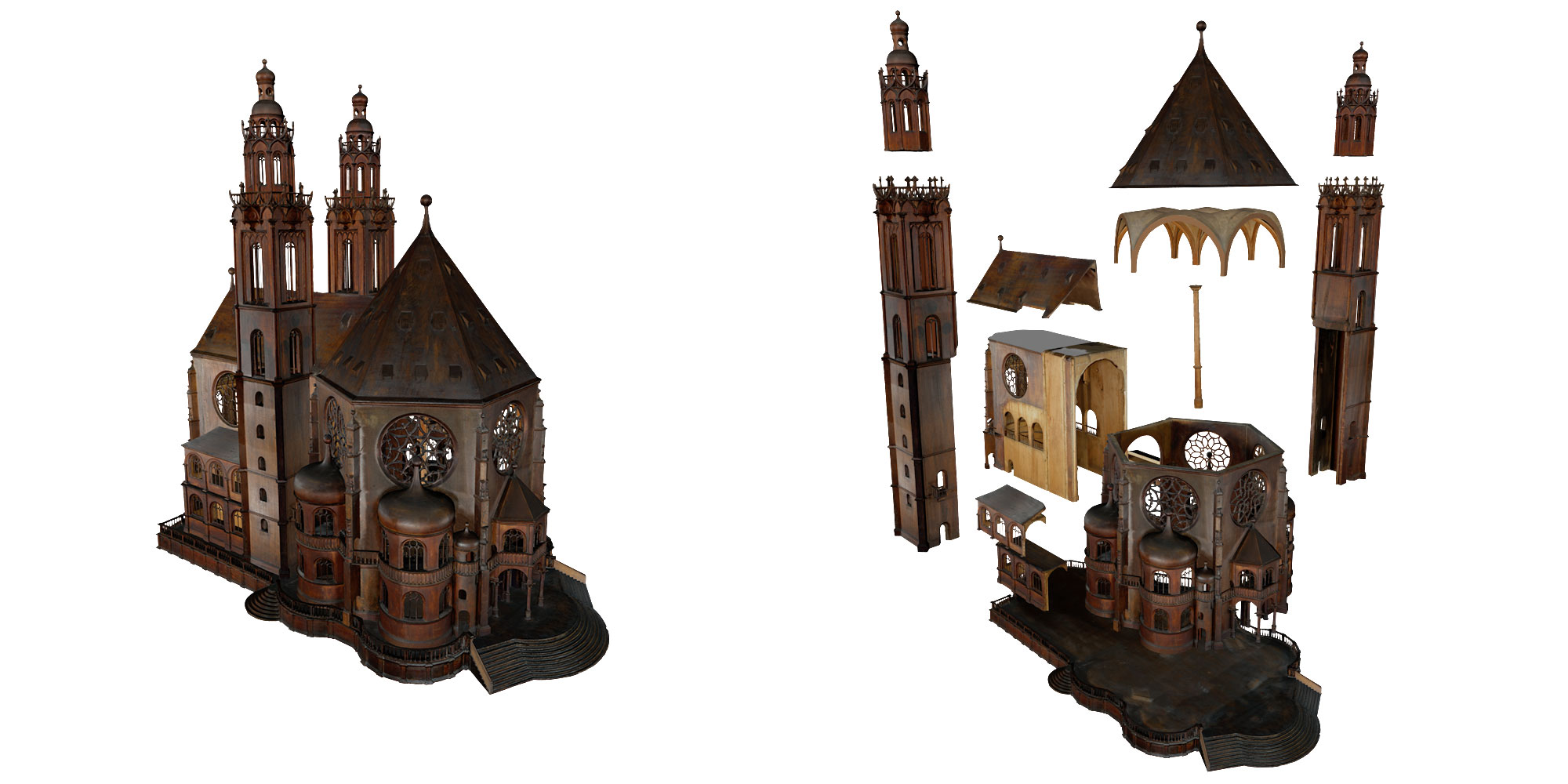
Laser & photos
Laser scanning meets state-of-the-art photogrammetry – all in one package. Laser scanners are natively supported within the application and are also fully involved during the position estimation of a camera or laser scanner. This results in truly unbeatable accuracy.
- Reconstruction of missing parts with the help of photos
- Automatic filtering of moving objects
- Automatic processing of registered/unregistered laser scans and/or photos
- Improving and simplifying the registration of laser scans using photos and/or checkpoints
Analysieren & Fortsetzen
Super-fast design mode that aligns 500×12 megapixel images in less than 10 minutes on a notebook, right on the spot. Combine all types of data – images, laser scans, aerial photos…
Analyze directly on site and get what you need efficiently.
- Take photos and add them to a project
- Click on draft alignment
- Review the result
- Repeat steps 1-3 until the desired result is achieved.
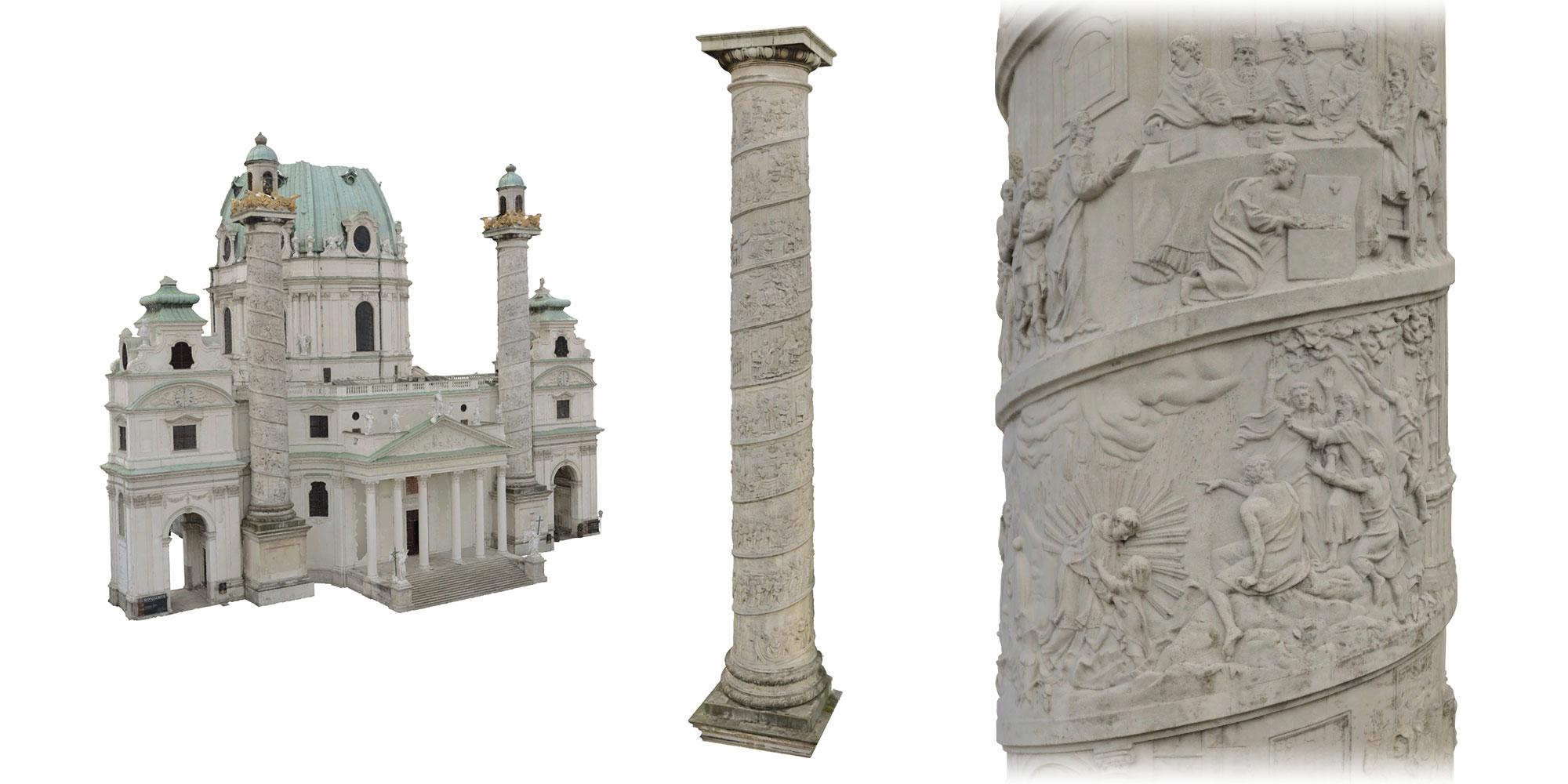
Create 3D models from photos, combine them with drone images and laser scan data for a fast and high-quality result! Create virtual reality scenes, textured 3D meshes, orthographic projections, geo-referenced maps and much more from images and/or laser scans completely automatically with the photogrammetry software RealityScan.
Function - Highlights
Update Notes
Tools Overview
Update Notes
RealityScan brings significant updates: from AI-assisted masking mode, alignment improvements and visual quality investigation to support for airborne laser scanning.
In previous versions processes have been continuously optimized for faster calculations — more specifically for depth maps. The new UserInterface UI enhances the functionality by switching to ribbon based navigation corresponding to the context of your active window — 2D, 3D, Help, etc. It’s a step-by-step walkthrough of the calculation process, while being able to refine and troubleshoot within each step. Also, some new troubleshooting tools are detecting misaligned cameras, visually seeing camera position uncertainties and controlling LODs (level of details).
Work effectively and isolate and calculate volumes and areas, view contours and create elevation profiles, calculate and export contour lines and cross sections, enable slope shading in terrain etc.
Key highlights from version 2.0 on:
- AI masking to automatically remove backgrounds
- More intelligent image alignment
- Combine LiDAR data and aerial images with ground data
- Quality analysis using visual heat maps
Distinctive Features:
- Faster model reconstruction and texturing
- Improved one-click model generation
- Mosaicing-based texturing and UV unwrap (Experimental)
- Direct upload to Nira
- Axis and transformation adjustment on import model dialog
- Updated resource cache behavior
- Support for PLY model import
- HEIC decoder metadata added
- Added render mesh from custom position – CLI commands + reporting system functions
- Added large triangle unwrap option to the level of detail export
- Revision of Inspection tool
And much more!
Tools Overview
AI masking
RealityScan interprets your object and separates it cleanly from the rest of the scenery to optimize your workflows from the captured photos to the final reconstruction data.
Smarter alignment
New default settings improve image alignment. Greater model consistency and fewer manual touch-ups.
LiDAR data support
Combine LiDAR data and aerial imagery with ground data to create accurate orthographic projections, maps and 3D models.
Quality analysis
Visual heatmaps allow you to identify areas that need more data before proceeding to the meshing step.
Ortho Projection using Image mosaicking
Option to create an ortho projection rendered from images rather than textured/colorized mesh.
Orthomosaic Editing
Allows to select a region and specify which cameras should be used for the orthomosaic generation – to fix possible visual issues, remove cameras that captured a moving car/person you don’t want in the orthomosaic.
Profile Measurements
Definition and elevation profile display of a drawn polyline/shape, identity of high and low points within the selected area.
Volume Measurements
Select a region, specify the base plane type and measure cut and fill volumes – useful for topographical surveys, identifying how much groundwork needed to level an area, as well as stockpile measurements.
Contours
Ability to display contours(isolines) to visualize the height profile of the displayed orthographic projection – users are able to set the min and max altitude and contour intervals. Giving a visual representation of how the land is falling and where the high and low points are – useful for topographical surveys and engineering workflows.
Cross Sections
Cross sections are mainly used within GIS workflows – they basically provide you with multiple profiles of an area along a specified plane – these can then be exported as shapefile/dxf format.
Cut by Box
Allows to remove triangles inside/outside box or slice.
Misalignment Detection Tool
A new option within the Inspect tool that can visually highlight camera misalignments.
Optimized LOD and add LOD Texture Format
New border decimation setting in Simplify Tool Option to keep border intact on simplification (keep original number of vertices along the borders, or make new simplified border) Ribbon 2.0 Other than that RC 1.2. version comes with major UI Improvements, as well. One Export, UX Improvements, better tool grouping
Faster depth maps calculation Ribbon 2.0 Additional Selection Tools
Polygon, Polyline, Adjustable Brush
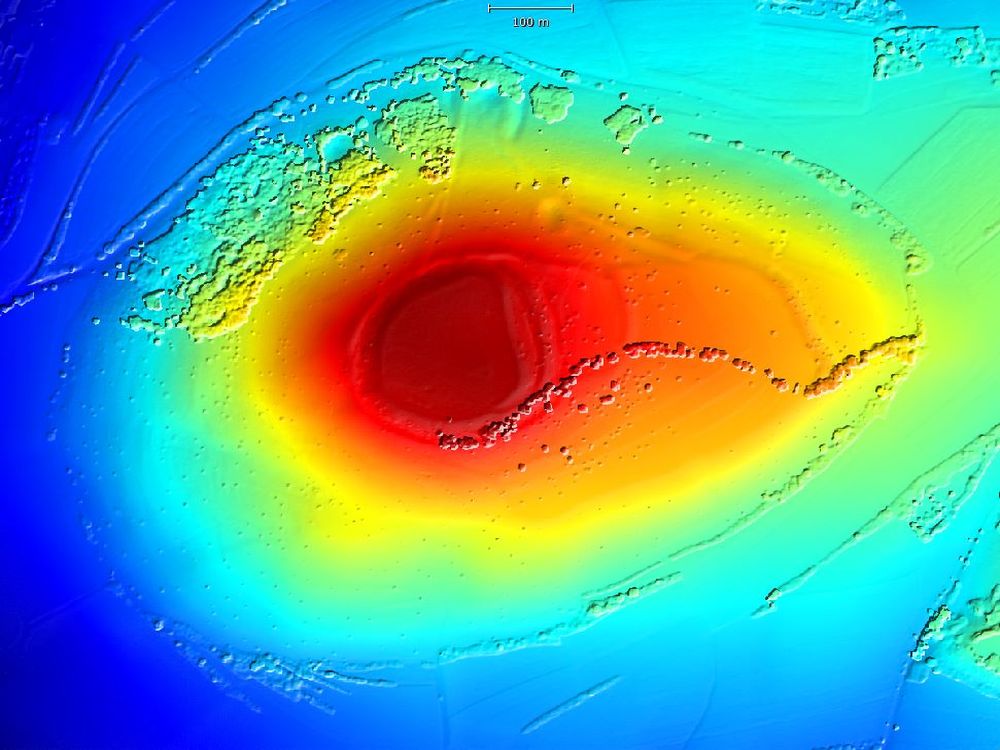
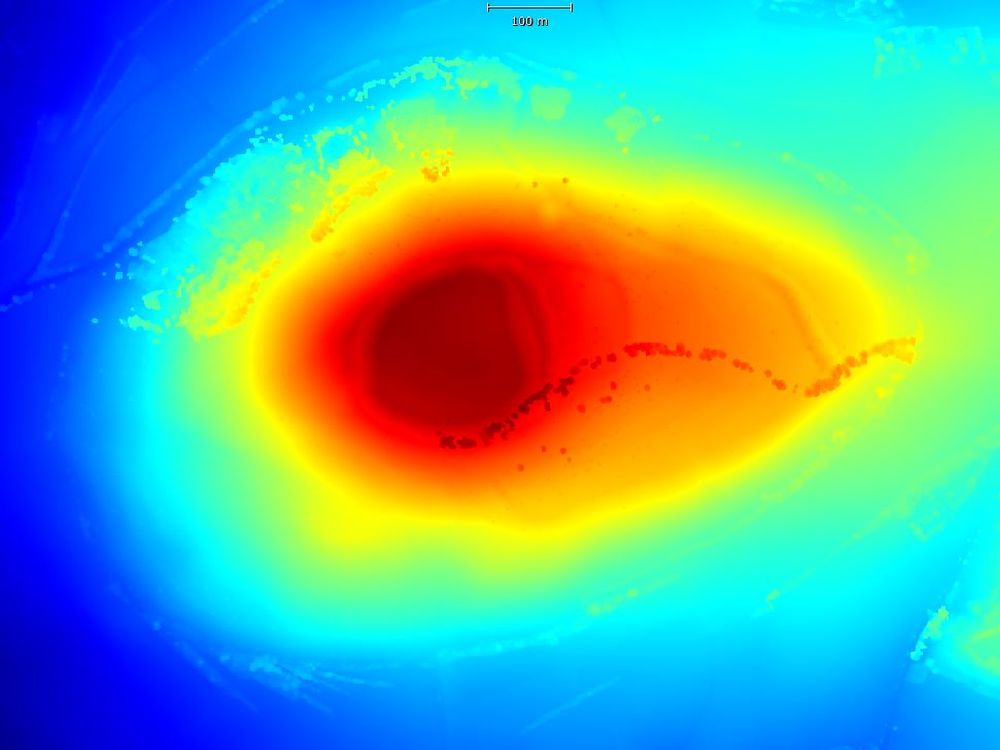
Contours
Create e.g. iso-lines on your terrain model
Cross Sections
Quickly and easily create cross sections
Cross Sections
You can also isolate cross sections
Mosaicking
Create mosaics on your digital terrain surface
Drawing Polygones
Like in GIS, trace the 3D area on an orthophoto and export the shape.
Elevation Profiles
Create elevation profiles and calculate the selected area (area calculation)
Profile Measurements
Example: display excavation profiles with a line
Display profile measurement
Display profile measurement
Color Corrections
Match and optimize true to original colors
Volume Measurements
Calculate volume of selected areas
Volume in 3D
Calculate cut and fill volume
Boundless
Unlimited number of photos, unlimited scene sizes, unlimited detail. Algorithms automatically divide the problem into smaller parts that best fit your hardware.
- Multi core, multi GPU
- Each part is prepaired in parallel
- The result behaves like a single model, without artifacts.
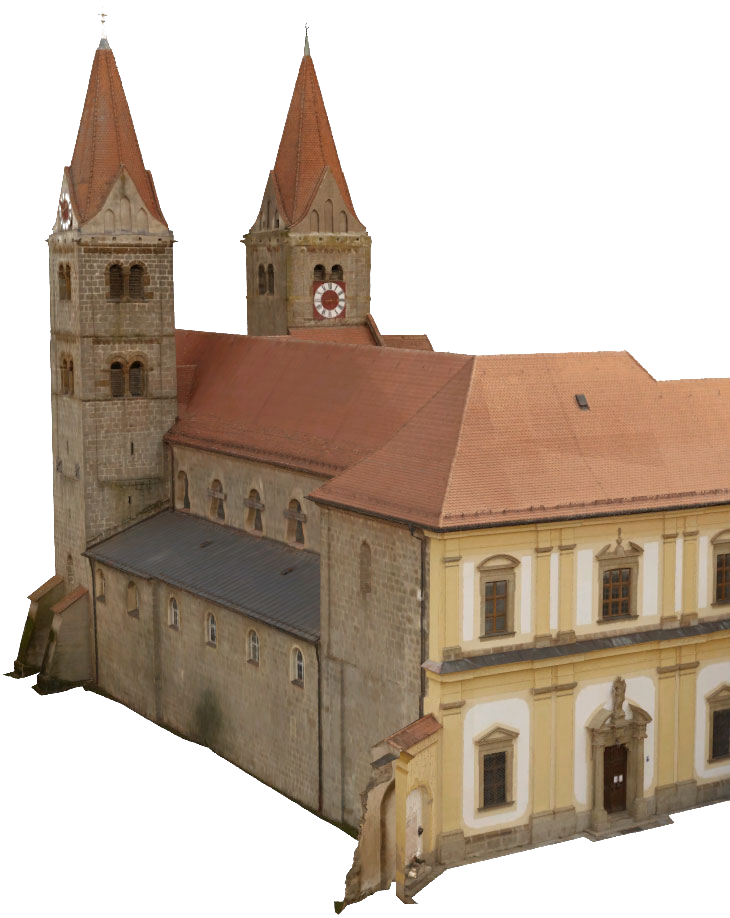
RealityScan brings great freedom to your work. Just concentrate on your goals and let the software do the rest. You don't have to limit yourself to a small number of photos because RealityScan is amazingly fast. With the appropriate computer equipment, the calculation of several thousand images is possible.



Unreal Engine Subscription
For individuals and businesses with revenue exceeding $1M in the past 12 months.
€
2049
per year / per seat / price net + tax
-
Unlock access for one year at €2049 per seat
-
Access to learning materials
-
Community-based support
-
Free upgrade for one year from subscription purchase
Enquire about seats
You need an NVidia GPU with CUDA 3.0+ (CUDA Toolkit 10.2, minimal driver version 441.22) and 1GB VRAM to be able to use the software.
RealityScan Subscription
For individuals and businesses with revenue exceeding $1M in the past 12 months.
€
1379
per year / per seat/ price net + tax
-
All RealityScan features for one year at €1379 per seat
-
Access to learning materials
-
Community-based support
-
Free upgrades for one year from subscription purchase
Enquire about seats
You need an NVidia GPU with CUDA 3.0+ (CUDA Toolkit 10.2, minimal driver version 441.22) and 1GB VRAM to be able to use the software.
Twinmotion Subscription
For individuals and businesses with revenue exceeding $1M in the past 12 months.
€
505
per year / per seat/ price net + tax
-
All Twinmotion features for one year at €505 per seat
-
Access to learning materials
-
Community-based support
-
Twinmotion Cloud
Download now
You need an NVidia GPU with CUDA 3.0+ (CUDA Toolkit 10.2, minimal driver version 441.22) and 1GB VRAM to be able to use the software.
* The prices listed here are net prices and do not include sales tax. If you qualify for a free license (see FAQ), you must obtain it exclusively from the manufacturer, Epic Games.
FAQ
As of August 2026, the annual subscription costs €1,379 per seat (user), excluding VAT.
RealityScan is available free of charge for hobby users, students, educational institutions, and small businesses that have generated less than USD 1 million in gross revenue during the previous 12 months.
The price of commercial RealityScan licenses depends on your company’s annual gross revenue.
Free licenses are available exclusively through the official Epic Games website. ArcTron 3D provides licensing and support only for B2B customers with annual revenues exceeding USD 1 million.
If you are unsure whether you qualify for a free license, please review the official license terms (EULA):
https://www.realityscan.com/eula-reference/realityscan-de
Government organizations may obtain RealityScan free of charge when it is used for non-commercial purposes. In this case, the revenue thresholds do not apply.
Government organizations intending to use RealityScan for commercial purposes must procure the software through a third-party organization that is subject to the applicable licensing terms and revenue thresholds.
RealityScan is the successor to RealityCapture.
Since Version 2.0, Epic Games has continued development of its professional desktop photogrammetry solution under the RealityScan brand.
Existing RealityCapture users can continue their workflows seamlessly with RealityScan. ArcTron 3D assists businesses with licensing questions and the migration from RealityCapture to RealityScan.
AMD GPU Support
With the release of RealityScan 2.2, Epic Games removes major hardware barriers by introducing one of the community’s most requested features: full AMD GPU support.
RealityScan 2.2 extends GPU acceleration beyond NVIDIA and now supports hardware-accelerated reconstruction on a wide range of AMD Radeon graphics cards and Ryzen AI Max processors.
Every reconstruction stage previously accelerated on NVIDIA GeForce and Quadro GPUs is now equally accelerated on Radeon and Radeon PRO hardware.
Even better, you don’t have to choose between vendors.
RealityScan can utilize AMD and NVIDIA GPUs simultaneously within the same workstation, distributing reconstruction tasks across all supported GPUs in parallel. For example, if your computer contains both a GeForce and a Radeon GPU, both will contribute to the reconstruction process, providing greater hardware utilization and significantly faster processing.
The current release supports the complete range of modern AMD desktop and workstation hardware—from RDNA 4 gaming GPUs to RDNA 3 PRO workstation GPUs.
Available on Windows. Linux support will follow in a future release.
Newly Supported AMD GPUs and APUs
RDNA 3 (gfx1100): Radeon RX 7900 XTX / XT, Radeon PRO W7900 / W7800
RDNA 3 (gfx1101): Radeon RX 7800 XT, RX 7700 XT, Radeon PRO W7700
RDNA 3 (gfx1102): Radeon RX 7600 XT, RX 7600, RX 7650 GRE
RDNA 3.5 (gfx1151): Ryzen AI Max Series (“Strix Halo”) APUs
RDNA 4 (gfx1200): Radeon RX 9060 XT, RX 9060
RDNA 4 (gfx1201): Radeon RX 9070 XT, RX 9070, RX 9070 GRE, Radeon AI PRO R9700
Yes.
RealityScan processes both traditional photogrammetry data and terrestrial laser scan data.
Supported formats include:
E57
LAS
LAZ
PTX
This allows laser scans and photographs to be registered within the same project and merged into a unified, highly accurate 3D model.
The RealityScan Learning Library provides detailed hybrid workflows for LiDAR and image data.
Depending on the project requirements, ArcTron uses laser scanners from manufacturers such as RIEGL, Leica, Artec 3D, and Shining 3D, combining laser scan data with photogrammetry to create high-quality reality capture projects.
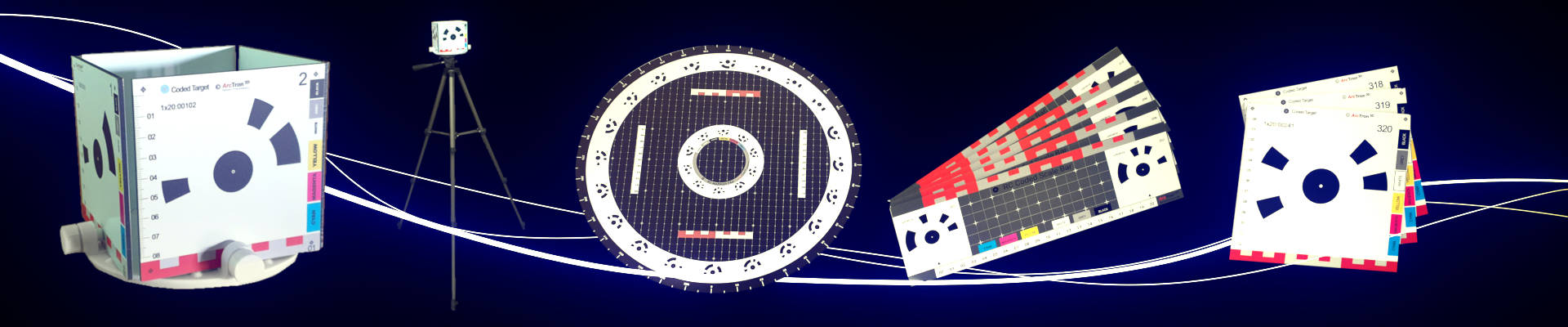
To optimize your RealityScan workflow, ArcTron offers durable, reusable RealityScan Coded Targets.
They provide several important advantages:
Faster, more accurate image alignment
Simplified registration of complex scenes
Eliminates the need for manually adding tie points
Can also be used as Ground Control Points (GCPs)
Improves sensor fusion between laser scans, photographs, and video frames
Supports scene scaling using known measurements
Automatically identifies marker positions for increased accuracy
Specifically designed and manufactured for RealityScan photogrammetry workflows
Which Coded Targets Are Available?
ArcTron offers RealityScan Coded Targets in several standard sizes:
Small Coded Targets (10 × 10 cm)
Medium Coded Targets (15 × 15 cm)
Drone Coded Targets (55 × 55 cm)
Coded Scale Bars (20 cm measuring length)
Coded Scale Bars (100 cm measuring length)
A4 Marker Pad
Photogrammetry Turntable (40 cm diameter)
Custom-made targets are also available upon request.
CodedTargets gibt es in folgenden Größen:
Kleine CodedTargets 10x10cm
Mittlere CodedTargets 15x15cm
Drohne CodedTargets 55x55cm
Coded ScaleBars, Messlänge 20cm
Coded ScaleBars, Messlänge 100cm
Markerpad A4
Photogrammetrie Drehteller, Durchmesser 40cm
Auch Maßanfertigungen sind möglich. Weitere Informationen finden Sie hier…
Simply send an email to info@arctron.de.
We will prepare a formal quotation, which you can approve and place your order by replying via email.
Most of our customers are large enterprises, public authorities, and government organizations that require formal quotations for internal procurement and approval processes before placing an order. They also frequently require agreed payment terms.
For this reason, ArcTron does not operate a conventional online shop. Instead, we provide personalized quotations, professional consultation, and tailored licensing support throughout the procurement process.
Photogrammetry Accessories
manual, only works with RealityScan from Epic Games
Coded Targets / Marker in different versions
-
For faster and more precise alignment and for easy scaling
-
Works only with RealityScan (not with other photogrammetrie software products)
-
Plate Material: AluDibond semi matt surface
-
Available for recording objects in various sizes
NEW
Coded Targets for Reality Capture
- Faster, more accurate and optimized alignment
- Simplifies the registration process for complex structures
- Manual addition of tiepoints no longer necessary
- Can also be used as (ground) control points
- Improve the fusion of active and passive sensors - laser scans, photos and video frames
- Existing measurement unit aids with scaling scenes
- Automatically mark position for higher accuracy
- Produced and suitable exclusively for the Reality Capture photogrammetry software
RealityScan Project Example: Bunker Complex in Denmark
WW - II Bunkers in LØKKEN - View Interactive 3D Model