- Client
- Hofheim am Taunus Town Museum
- Content
- Programming of VR application, historical landscape reconstruction
- Related topics
- VR application museum exhibition
- georgenburg VR application
- Schlagwörter

Today, Kapellenberg near Hofheim am Taunus is mostly covered in forest. However, around 6,000 years ago, in the Neolithic period, it was home to one of the largest Neolithic settlements in Central Europe: an impressive complex belonging to the Michelsberg culture, covering an area of over 70 hectares and presumably housing several thousand inhabitants.
Two specially developed virtual reality applications were created for the Hofheim am Taunus City Museum, giving visitors an immersive insight into Neolithic life on Kapellenberg. Both VR experiences take different approaches – from a narrative-led experience to interactive stations with modern hand tracking.
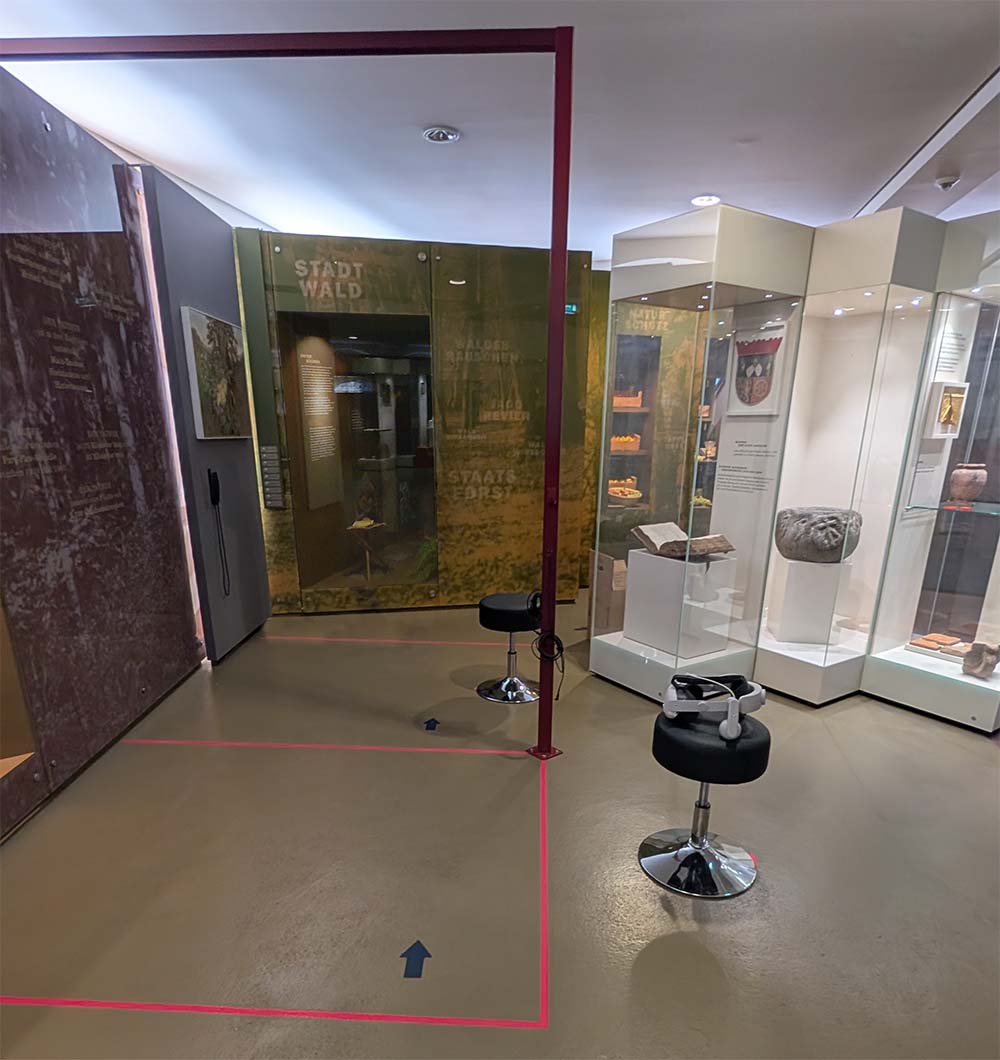
In the first VR application, visitors experience a guided virtual journey: they slip into the role of a child who, together with his father, makes his way up to the Neolithic settlement on Kapellenberg. Most of the experience takes place on the back of an ox, which leads the way up the path to the settlement.
This deliberately passive VR experience allows users to immerse themselves fully in the reconstructed environment. Without controllers or complex inputs, users can look around freely, listen to the dialogues and immerse themselves completely in the virtual world. The application is divided into four narrative chapters that gradually approach the settlement, imparting knowledge about everyday life, the environment and culture of the Neolithic period.
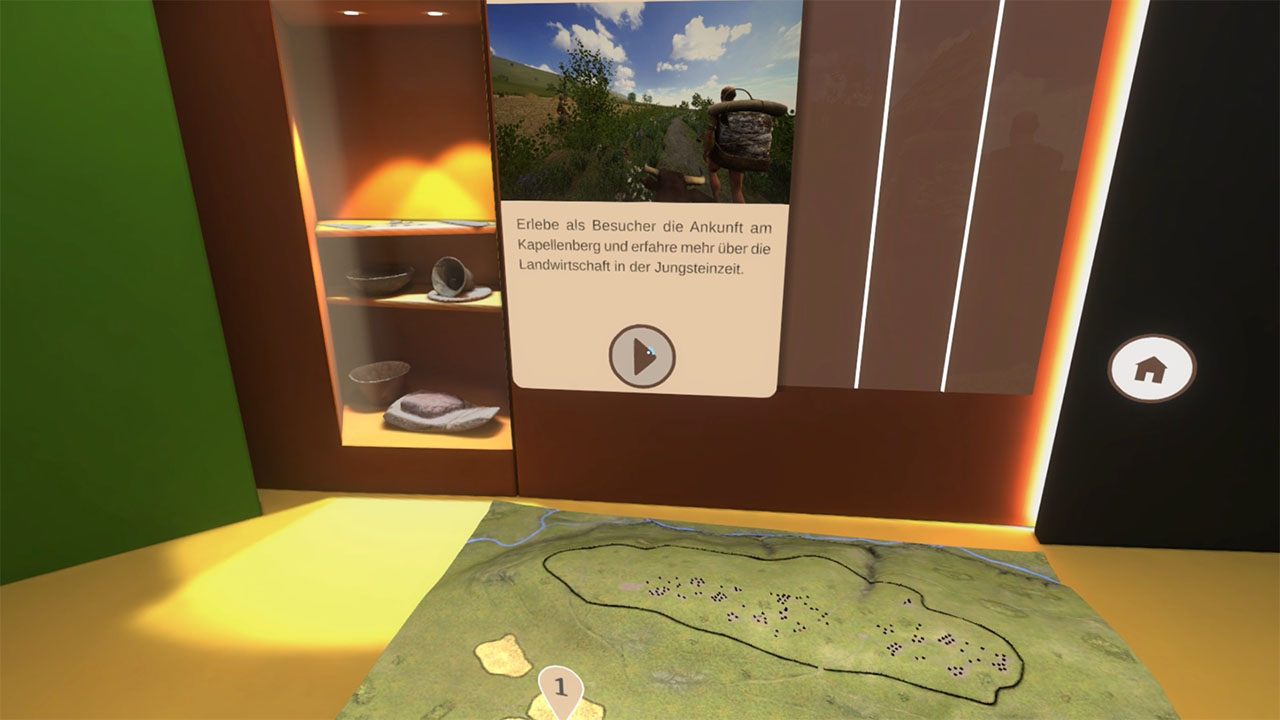
The chapters are selected in a virtual museum room. Navigation is controlled by eye movement (head gaze interaction), making operation particularly intuitive and accessible. Chapters that have already been viewed can be played again before moving on to the next section.
The museum space is complemented by a virtual 3D model of the Kapellenberg, on which additional information is displayed after each chapter – accompanied by explanatory narration.
While the first application focuses on narrative immersion, the second VR application offers an active, interactive experience. Instead of classic VR controllers, modern and particularly user-friendly technology is used here: hand tracking.
Users interact directly with their own hands and fingers in virtual reality. Virtual objects can be grasped, moved or assembled, and buttons are triggered by natural hand movements. This form of interaction provides a particularly simple, intuitive and realistic VR experience that differs significantly from classic VR games.
Here, too, a virtual museum space serves as the central starting point. From there, four interactive stations with varying degrees of difficulty can be selected:
The two VR applications impressively demonstrate how virtual reality brings historical and archaeological content to life in new ways. The combination of narrative guidance, intuitive interaction, immersive 3D reconstructions and modern input methods such as hand tracking creates a communication format that not only imparts knowledge, but also makes it emotionally tangible.